
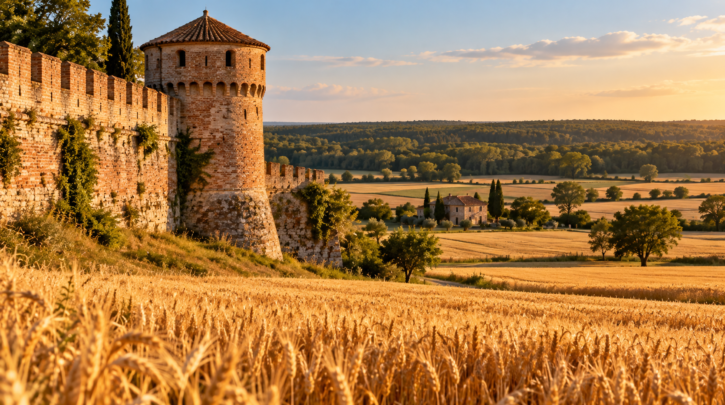

If your family came from the Croatian or Slavonian interior and a story says they were frontier people, soldier-farmers or Grenzer, you are dealing with one of the most unusual administrative units in Europe. The Military Frontier was ruled by the army, not by counties, and that left a record trail in military archives that civilian families do not have. This guide explains Military Frontier genealogy for Croatian and Slavonian families: what the Frontier and the Kingdom of Slavonia were, when the system ended, which records the army kept and where they are now, and where the sources disagree or run out. It draws on reference articles, FamilySearch, a research guide to Croatian holdings and the Austrian State Archives’ own guide, as of October 2026.
What the Frontier was
The Croatian Military Frontier was a district of the larger Military Frontier, a territory in the Habsburg monarchy, first within the Austrian Empire and then within Austria-Hungary, according to a reference article. A reference article on the Kingdom of Croatia says it was ruled directly from Vienna’s military headquarters and not by the Croatian authorities. The Slavonian Military Frontier was established in 1745 and was divided between three regiments, according to another reference article. In that year, northern Slavonia was placed under civil administration as the Kingdom of Slavonia, while the southern parts that stayed under military administration became the Slavonian Military Frontier. The people who lived there were the Grenzer, border guards who served in regiments and farmed, and the Frontier’s population was large: the Slavonian Frontier had 246,901 inhabitants in the official census of 1870.
When it ended
- 8 August 1873: the Croatian Military Frontier was demilitarized, according to a reference article.
- 1881: the Croatian and Slavonian Military Frontier were incorporated into Croatia-Slavonia, according to a timeline and a reference article on the Croatian-Hungarian Settlement.
- The aftermath: between 1871 and 1881 the Frontier was disbanded and the counties of Croatia-Slavonia were reorganized.
The two dates are easy to confuse. Demilitarization in 1873 ended military administration, and incorporation in 1881 finished the merger into the civil kingdom. A document from the years between may use either structure. Our regions and ruling states guide puts these dates beside the others.
Free Download
Not sure where to start with your Croatian ancestry?
Get the Croatian Genealogy Quick-Start Checklist: six research steps in order, the six terms you’ll see everywhere (matične knjige, župa, status animarum and more), and the one free record collection to bookmark first.
The records the army kept
| Record | What it is | Where it is, according to the sources |
|---|---|---|
| Military parish registers (military metric books) | Baptisms, marriages and deaths recorded by military chaplains | The Austrian State Archives’ guide lists them among the Kriegsarchiv’s holdings, and says the Croatian State Archives also hold an important fonds of Austro-Hungarian military parish registers |
| Central Command records | The records of the oldest central military command, the only possible source on Austrian soldiers and officers before 1740 | A research guide to the Family History Library’s holdings lists commissions from 1466 to 1866 among genealogically relevant series |
| Service records | Records of individual units, with information about an officer’s service and often parentage | The same guide gives the dates 1823 to 1918 |
| War graves documents | Burial records of war deaths reported to Vienna | The Austrian State Archives’ guide lists them among the Kriegsarchiv’s holdings |
FamilySearch says most military records of Croatia are under the guardianship of the Wiener Kriegsarchiv in Vienna, that they divide into two large groups, Central Command and Individual Units, and that many documents from after 1867 were claimed by the empire’s successor nations. The research guide says the overwhelming majority of Croatian and Slavonian military records microfilmed by the Family History Library are from the Military Archives in Vienna, and that the Kriegsarchiv collection is no longer intact. The Austrian State Archives’ guide adds a procedural point: a waiting period of 100 years is relevant to the military parish registers kept in the Vienna War Archives. We did not verify how that rule applies to a given request.
The civilian trail alongside the military one
- Parish registers. Frontier families also appear in ordinary Catholic and Orthodox registers. The State Archives in Bjelovar preserve registers of Roman Catholics, Greek Catholics, Orthodox Christians, Jews and Evangelicals from its area, microfilmed at the Croatian State Archives and partly digitized.
- The Croatian State Archives. Their register collection is primarily for northwestern Croatia and to a lesser degree for Slavonia, according to a guide to Croatian archives.
- FamilySearch. Its Croatian church books for 1516 to 1994 include military congregations alongside Roman Catholic, Orthodox and Jewish ones.
- The language. German is the language of record for Austrian military documents, according to FamilySearch.
Free trial
Ready to put your research into a family tree?
Start a free MyHeritage trial to build your tree online and search historical records and other family trees as you add each generation.
A worked example, invented for illustration
Example (invented, for illustration only): A reader’s great-great-grandfather is said to have been a Grenzer from the Slavonian side. She finds the village on a map, learns that the region was in the Slavonian Military Frontier until 1873 and was incorporated into Croatia-Slavonia in 1881, and searches FamilySearch’s church books, including the military congregations. She also writes to the Croatian State Archives with the subject genealogy to ask about military parish registers for the area, and notes that service records, if any, will be in German and probably in Vienna.
Questions for a frontier line
- Was the village in the Frontier or in the civil Kingdom of Slavonia in the year of the event?
- Which regiment district did it belong to? The Slavonian Frontier had three regiments.
- Is the event after 1873 or 1881, when the administrative structure changed?
- Was the ancestor a soldier or an officer, which determines which military series might name him?
- Which confession was the family?
What we could not verify
- Which regiment district each village belonged to, since we did not find a village-by-village list.
- How the 100-year waiting period applies to a request from a descendant.
- Which military parish registers the Croatian State Archives hold for which areas.
- Fees, turnaround and access at the Kriegsarchiv.
Sources include a reference article on the Croatian Military Frontier, one on the Slavonian Military Frontier, one on the Habsburg Kingdom of Croatia, one on the Kingdom of Slavonia, FamilySearch’s page on Croatian military records, a guide to Croatian research at the Family History Library, the Austrian State Archives’ guide to genealogy in the War Archives and a guide to church records and archives in Croatia.
This guide is part of the regions and ruling states guide. More are in Regions & Empires, and the records map explains the periods and languages.
Disclosure: Croatian Roots may earn a commission if you buy through some links on this page, at no extra cost to you. Our affiliate disclosure explains how we handle that.
