
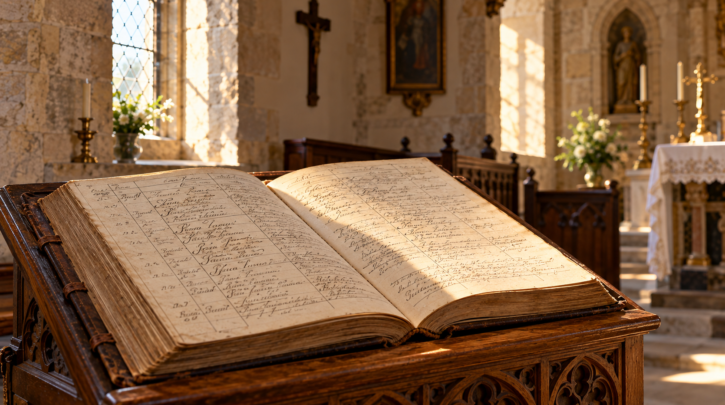

A Croatian parish register is a dense little document. One baptism line can name the child, the parents, their village and the godparents, but only if you can tell which column is which and which language you are reading. This guide explains what a Croatian parish register is, what each kind of entry records, how the 1784 layout shaped it, which languages and scripts to expect and which words unlock an entry. The sources are FamilySearch’s Croatia pages, the Croatian State Archives and a guide to Croatian archives, as of October 2026.
What the register is, and why faith matters
Until 1946, parish registers were created and maintained by religious communities, so a researcher needs to know the faith and the parish of the family, according to a guide to Croatian archives. In Croatian the registers are called matične knjige. FamilySearch notes that Croats are almost exclusively Roman Catholic and Serbs Orthodox, and that Roman Catholic parishes kept registers earlier than Orthodox ones, which were required to keep them only after 1777. The collection of Croatian church books at FamilySearch for 1516 to 1994 includes Roman Catholic, Serbian Orthodox, Jewish and military congregations, so the first question for any ancestor is which community recorded the event.
What each kind of entry tells you
| Entry | What FamilySearch says it usually contains |
|---|---|
| Baptism or birth | The date and place of baptism, the name of the infant, gender and date of birth, legitimacy, religion, the parents’ names, residence and place of origin, and the names of witnesses or godparents |
| Marriage | The date and place of the event, the names of bride and groom, their civil status at the time (widowed, single, divorced), their places of origin and residence, the names of their parents and the witnesses |
| Death or burial | The place and date of death, the name of the deceased, civil status and the name of a spouse if married, the parents’ names and sometimes the place of burial |
Treat those lists as the best case. A seventeenth-century entry may be much shorter, and an entry’s detail depends on the period and the priest. Even so, a baptism that names the parents’ place of origin is often the document that gets you from a family story to a village.
Free Download
Not sure where to start with your Croatian ancestry?
Get the Croatian Genealogy Quick-Start Checklist: six research steps in order, the six terms you’ll see everywhere (matične knjige, župa, status animarum and more), and the one free record collection to bookmark first.
The 1784 patent and the standard layout
A patent of Emperor Joseph II in 1784 required certain sections in all parish record books kept by the clergy, and the registers were later also used as civil vital records, according to FamilySearch. Baptism records, for example, had to contain separate sections for the date and place of birth. FamilySearch adds that a tabular format was adopted after 1848 and that civil transcripts of registers were mandated during the nineteenth century. In the collection of church books for 1516 to 1994, FamilySearch also says that from 1868 the Ministry of Internal Affairs took over the right to supervise the maintenance of these records. In practice, later entries are likely to be easier to read because their columns are consistent, while earlier ones may run as lines of text.
Languages and scripts you may meet
- Latin, the main church language, used extensively by the Roman Catholic Church.
- Croatian, used for most Roman Catholic registers after the Latin period.
- Italian, common in the registers of Dalmatia and Istria from about 1600 to 1800.
- Hungarian, found in civil documents of the Austria-Hungary period.
- German, the language of record for the Austrian military.
- Glagolitic and Cyrillic scripts, which appear alongside Roman script, according to FamilySearch. A researcher’s guide to the Family History Library says the vital records of a single parish in northern Dalmatia can be in Glagolitic, Italian, Latin, Croatian and Hungarian.
FamilySearch’s pages on Croatian collections point to a separate page on the Glagolitic script and to Latin, Italian, German, Hungarian and Serbo-Croatian word lists. Do not expect one language per register. A single parish may change language over time, as the Dalmatian example shows.
Record translation
Register in Latin, Glagolitic or Cyrillic?
Polytranslator translates scanned records, handwriting and older scripts into the language you choose. Always check names and dates against the original image.
Twenty words that unlock an entry
The words below are taken from FamilySearch’s Bosnian, Croatian and Serbian word list, which it describes as the words you are likely to find in genealogical sources. Spellings vary, and endings change with grammar, so look for the stem.
| Croatian | English |
|---|---|
| krštenje, krst | baptism, christening |
| rođenje, rodjenje, rođeni | birth, born |
| vjenčanje, vjenčani | marriage ceremony, married |
| brak | marriage |
| smrt | death |
| pogreb | burial, funeral |
| kum | godfather, godparent |
| kuma | godmother |
| otac, oca | father |
| roditelji | parents |
| dijete, dete | child |
| mladoženja | groom |
| mlada, nevjesta, mladenka | bride |
| župa, parohija | parish |
| prezime | surname |
| rodj | born, maiden name |
| prebivalište | residence |
| pokopan | buried |
| popis duša | census of souls |
| rimo-katolićki, pravoslavni | Roman Catholic, Orthodox |
The list gives rodj as born or maiden name, so a woman’s maiden surname may be introduced that way. We did not find a source that translates the column headings of Latin-language registers, so use FamilySearch’s Latin word list for those. The census of souls, popis duša, appears to be the kind of record that the Croatian State Archives hold as status animarum books, though we did not find a source that equates the two terms.
A worked example, invented for illustration
Example (invented, for illustration only): A reader opens a nineteenth-century baptism register from a Dalmatian parish and finds a line in Italian. She looks for the date, then the child’s name, then the parents. The word for godparent is not one she knows, so she checks FamilySearch’s Italian word list. The entry names a father and mother and a village of origin for the mother, which differs from the village the family story gives. She records both, copies the entry in the original language and checks the next volume for the siblings.
Free trial
Ready to put your research into a family tree?
Start a free MyHeritage trial to build your tree online and search historical records and other family trees as you add each generation.
Habits that save time
- Copy each entry exactly as written before you translate it, and keep the original beside your reading.
- Record the collection, the parish, the volume, the year and the entry number.
- Note the language and script of each volume, since they can change within a parish.
- Compare parents, godparents and place across entries before deciding two people are one.
- If the surname does not match, try the Italian, Hungarian or Croatian form, and ask the archive which register holds the parish.
Sources include FamilySearch’s page on Croatian church records, its page on Croatian languages and key words, its Serbo-Croatian word list, its page on the Delnice Deanery collection, a guide to church records and archives in Croatia and a guide to Croatian research at the Family History Library.
This guide belongs to the complete Croatian genealogy guide. More are in Parish Books & Archives, and the records map shows which periods and places the registers cover.
Disclosure: Croatian Roots may earn a commission if you buy through some links on this page, at no extra cost to you. Our affiliate disclosure explains how we handle that.
