
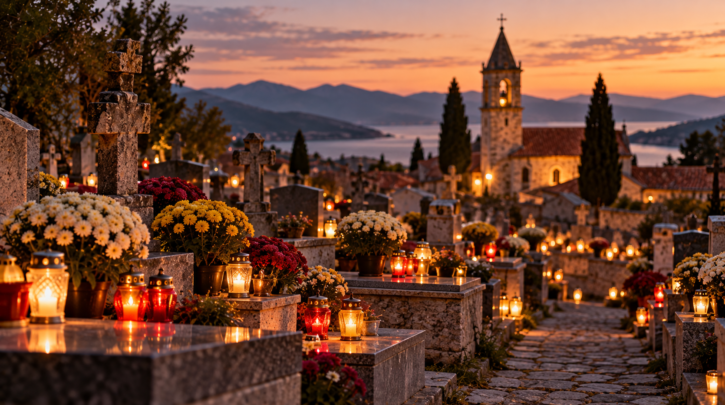

Two kinds of date matter on a Croatian roots trip: the days when offices and archives are shut, and the days when cemeteries are full. They overlap in early November, when All Saints’ Day in Croatia draws families to the graves of their dead and closes much of the country for the day. This guide explains which Croatian public holidays you should plan around, what the sources say about cemetery customs on 1 November, how holidays affect archives, registry offices and churches, and how to plan a village visit for or around those days. It was written in October 2026 and uses holiday lists, news reports and archive pages, and it says where we could not confirm a detail.
Public holidays that close offices
An expatriate guide to Croatian public holidays says that on these days government agencies and many businesses across the country are closed, and counts 14 national holidays. Wikipedia’s list of Croatian public holidays is regulated by the Holidays, Memorial Days and Non-Working Days Act and includes, among others, 1 November, All Saints’ Day, 18 November, the Day of Remembrance for the Victims of the Homeland War, which became a public holiday in 2020, and 26 December, Saint Stephen’s Day. The list also says some cities celebrate de facto public holidays on their patron saints’ feast days, which can close offices locally in a way a national list does not show.
| Date | Holiday | What it means for a trip |
|---|---|---|
| 1 November | All Saints’ Day, Dan svih svetih | A public holiday. Offices and many businesses are closed, and cemeteries are busy |
| 2 November | All Souls’ Day, Dušni dan | Listed on an expatriate guide’s table of holidays and memorial days. We did not confirm whether offices close |
| 18 November | Remembrance Day, Dan sjećanja | A public holiday, in memory of the victims of the Homeland War, and a day of remembrance in Vukovar |
| 25 and 26 December | Christmas and Saint Stephen’s Day | Public holidays |
| A town’s patron saint’s day | Local, and not on national lists | May close offices locally, according to Wikipedia |
The dates in a given year fall on different weekdays. A site lists 1 November 2026 as a Sunday and 1 November 2027 as a Monday, so in 2027 the holiday would take a weekday. Check the calendar for your own travel dates.
Free Download
Not sure where to start with your Croatian ancestry?
Get the Croatian Genealogy Quick-Start Checklist: six research steps in order, the six terms you’ll see everywhere (matične knjige, župa, status animarum and more), and the one free record collection to bookmark first.
How holidays affect archives and registry offices
- Pazin. The State Archives in Pazin say their reading room is closed at weekends and holidays.
- Zadar. The State Archives in Zadar say the reading room keeps its ordinary hours when a public holiday falls on a Thursday, which shows that holidays alter the schedule. We did not find its full holiday calendar.
- Zagreb. A visitor site says the Croatian State Archives are closed on weekends and public holidays, and the archives’ own page gives hours for weekdays only. Our archives guide lists them.
- Registry offices and churches. We did not find published holiday schedules, so ask in advance.
The safe plan is to do archive work before or after a holiday cluster and to ask each office by email which days it will be shut. Add the local patron saint’s day to the list for any village or town you will visit.
All Saints’ Day in Croatia: what happens at the cemeteries
A news report from Croatia Week describes the day: Croatians visit cemeteries, light candles and place flowers in memory of the dead, and All Saints’ Day on 1 November is a national public holiday. The same report says that Mirogoj Cemetery in Zagreb drew large crowds that morning and that officials honored those who lost their lives in the war at Mirogoj and in Vukovar. A 2026 travel guide describes the day as contemplative and family-focused, with candles on graves and, in the evening, cemeteries across the country glowing with thousands of candles, which it calls particularly striking at Mirogoj. These are descriptions from the press and a travel site, not rules for visitors.
- Graves are tended and visited. A family grave you are looking for may be at its best, and you may meet relatives or neighbors there.
- It is a family occasion. Visitors are welcome to be quiet and respectful, but the cemetery is full of people grieving.
- Expect crowds in cities. The Zagreb report mentions large crowds at Mirogoj, and we found no source on traffic or parking, so allow extra time.
Taking part respectfully
These points are our own advice, not rules from a source. Ask before photographing people at graves. If you light a candle, follow what others do and take your rubbish with you. Keep your voice low, and do not walk across graves. If you cannot find a family grave, ask a caretaker or the parish office. Record the grave’s position and copy any inscription exactly, as in our village guide. If you hope to meet relatives, a short note in Croatian with your name, the surname and the village, and your email address, is useful.
Planning around the first week of November
- Decide whether the point of the trip is the cemetery visit or the records. Both are valid, but they pull in different directions.
- If it is the records, finish archive work before 1 November, and do not book a registry office or a parish office for the holiday.
- If it is the cemetery, arrive early in the day, expect crowds in Zagreb and plan a quiet visit in a village for the evening.
- Check ferry timetables for the days around the holiday, since we did not verify whether schedules change, using our transport guide.
- Add a buffer day, as in our trip planning guide.
If you cannot travel then
Many families abroad light a candle for their ancestors on 1 November, and you can use the day to update a tree, read a register entry or write to a distant relative. We found no source that tells overseas families how to observe the day, so we offer this only as an idea.
A worked example, invented for illustration
Example (invented, for illustration only): A reader plans ten days in Croatia that end in the first week of November. She does her archive work in Zagreb in the last week of October, avoiding the holiday, then travels to her family’s village to arrive on 31 October. On 1 November she visits the village cemetery late in the afternoon, writes down the stone’s inscription and leaves a note in Croatian with her email address for anyone who might know the family. She does not try to visit the registry office or the parish office that day, and she plans a buffer day afterwards.
What we could not verify
- Whether offices close on 2 November, and how local patron saint days affect a particular town.
- Holiday schedules at registry offices, churches and regional archives.
- Whether transport schedules change on 1 November.
- How the observance varies by region and by community, since we read general descriptions.
Sources include an expatriate guide to Croatian public holidays, a reference article on public holidays in Croatia, a Croatia Week report on All Saints’ Day, a 2026 guide to Croatian holidays for travelers, a holiday calendar site, the Pazin archive’s page on working in the reading room and the Zadar archive’s page on its reading rooms. Several are secondary or commercial sources.
This guide is part of the complete guide to planning a Croatian roots trip. More are in Heritage Travel in Croatia.
Disclosure: Croatian Roots may earn a commission if you buy through some links on this page, at no extra cost to you. Our affiliate disclosure explains how we handle that.
