
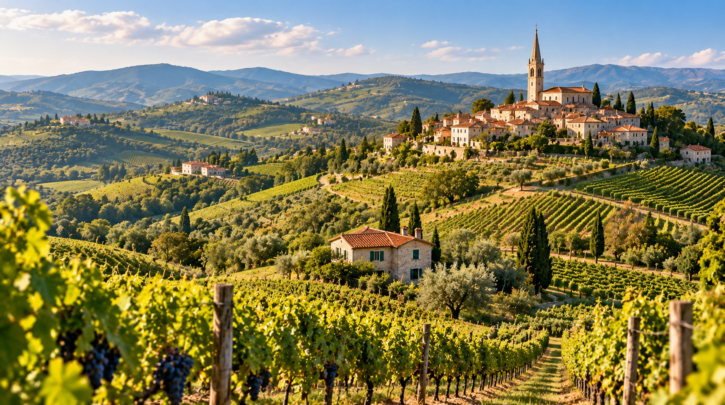

Međimurje, the small triangle of northern Croatia between the Mura and Drava rivers, has one of the most distinctive record trails in the country, and most Croatian guides skip it. For almost two centuries before 1918 it belonged administratively to Hungary, not to Croatia, which means its civil records are Hungarian, its villages carried Hungarian names for part of that time and its families may turn up in collections catalogued under Slovenia as often as under Croatia. This guide explains Međimurje genealogy: the Hungarian years, the civil registration that began in 1895, the renaming of villages in 1898, the 1918 to 1920 change of state and the places to search. It draws on reference articles, a Hungarian research guide, FamilySearch listings and the FEEFHS list, as of October 2026.
Two centuries under Hungary
From 1720 until 1918, except for two shorter periods, Međimurje belonged administratively to Zala County, in the southwest of the Kingdom of Hungary, whose seat was Zalaegerszeg, according to a reference article on Međimurje under Hungarian rule. A reference article on Zala County adds that Međimurje, known in Hungarian as Muraköz, is listed there as passing to Croatia in 1850, which may be one of the shorter exceptions, though we did not find the article spelling that out. The Hungarian name of its main town, now Čakovec, is Csáktornya. For a family historian, the lesson is that for most of the nineteenth century a Međimurje document was a Hungarian county document, even though most of the population was Croatian.
The renaming of 1898
The reference article says the peak of Hungarianization and of violence against the local language occurred in 1898, when the authorities introduced the renaming of all Croatian topographic names in Međimurje, so that the old Croatian names of the settlements were renamed into Hungarian, in a way the article calls caricatured. A document created after that year may name a village only by its Hungarian form, and one from before may use the Croatian form. Keep a list of both forms for each village in your tree and search both. We did not find a published table of the renamed villages, so check a gazetteer of the period.
Free Download
Not sure where to start with your Croatian ancestry?
Get the Croatian Genealogy Quick-Start Checklist: six research steps in order, the six terms you’ll see everywhere (matične knjige, župa, status animarum and more), and the one free record collection to bookmark first.
Hungarian civil registration from 1895
A Hungarian Jewish research guide says civil registration of vital events began throughout Hungary in 1895, and lists Međimurje, under its Hungarian name Murakoz, among the regions that belonged to the Kingdom of Hungary before the Treaty of Trianon in 1920. A genealogy society presentation adds that civil registration began on 1 October 1895 and included people of all faiths, and that before that date there were only registers run by religious communities. FamilySearch’s Croatian listings include a collection titled Croatia and Slovenia, Prekmurje and Međimurje, civil registers, 1895 to 1918. We did not open it, so we cannot describe its contents.
| Period | Kind of record | What it means |
|---|---|---|
| Before 1895 | Registers kept by religious communities | The parish registers described in our guide to reading a register |
| From 1 October 1895 to 1918 | Hungarian civil registers, covering all faiths | Civil entries in Hungarian, with Hungarian village names after 1898 |
| From 1918 and 1920 | Croatian and Yugoslav administration, confirmed at Trianon | A change of state, and eventually Yugoslav paperwork |
| From 1946 | Civil registration replaces parish registration across Croatia, according to FamilySearch | The post-war system described in our civil registry guide |
1918 to 1920: a new state
Međimurje was occupied by forces of the National Council of the State of Slovenes, Croats and Serbs between 13 November and 24 December 1918, and the Hungarian garrison in Čakovec surrendered on 24 December without resistance, according to a reference article. A public assembly in Čakovec on 9 January 1919 passed a resolution seceding from Hungary, and the Paris Peace Conference awarded the region to Yugoslavia, which the Treaty of Trianon of 4 June 1920 confirmed. Among the first acts of the new authorities, according to the article, was the banning of Hungarian-language newspapers. The practical effect is that records of 1919 to 1920 are a transitional layer. Our regions and ruling states guide puts the date beside the others.
A border that families crossed
The Treaty of Trianon divided Zala County, and the southwest of it, including Međimurje and the southeastern part of Prekmurje, went to the new Kingdom of Serbs, Croats and Slovenes. Most of Međimurje is now in Croatia, but the area around Lendava, in Prekmurje, is in Slovenia, and the rest of the county stayed in Hungary. A family from the Međimurje region may therefore appear in collections of Croatian, Slovenian or Hungarian records. FamilySearch’s collection title pairs Prekmurje and Međimurje for that reason.
Free trial
Ready to put your research into a family tree?
Start a free MyHeritage trial to build your tree online and search historical records and other family trees as you add each generation.
Where to search
- FamilySearch’s collection of Prekmurje and Međimurje civil registers for 1895 to 1918, and its Croatian church books for 1516 to 1994, as described in our guide to searching online.
- The Međimurje State Archive, which appears in the FEEFHS list of Croatian state archives. We did not find a description of its holdings, so write with the subject genealogy.
- The Croatian State Archives, which can say where registers are kept, as our archives guide explains.
- Hungarian and Slovenian sources for families on the other side of the line, which we do not cover in depth.
A worked example, invented for illustration
Example (invented, for illustration only): A reader’s grandfather was born in 1905 in a village near Čakovec. She learns that Međimurje was then part of Zala County, that civil registration had begun in 1895 and that all Croatian village names had been replaced by Hungarian ones in 1898. She searches FamilySearch’s Prekmurje and Međimurje civil registers for 1895 to 1918 under the Hungarian form of the village, finds nothing, tries the Croatian form and finds an entry in Hungarian. She then looks in the parish register for the siblings, and notes that the family later appears on the Slovenian side of the border.
Questions for a Međimurje line
- Is the event before or after 1 October 1895?
- Is it before or after 1898, when village names were Magyarized?
- Is it before or after 1918 to 1920?
- Which form of the village name and the surname will the document use?
- Might the family have lived on the Slovenian or Hungarian side of the border?
What we could not verify
- What the FamilySearch collection of Prekmurje and Međimurje civil registers contains, since we saw only its title.
- A table of the renamed villages.
- The holdings, fees and turnaround of the Međimurje State Archive.
- How Hungarian civil registration was handled in the first years of Yugoslav rule.
Sources include a reference article on Međimurje under Hungarian rule, one on the 1918 occupation of Međimurje, one on Zala County, a Hungarian Jewish research guide, a genealogy society presentation on Hungarian ancestors, a listing of Croatian records at FamilySearch and a list of Croatian online records.
This guide is part of the regions and ruling states guide, and more are in Regions & Empires.
Disclosure: Croatian Roots may earn a commission if you buy through some links on this page, at no extra cost to you. Our affiliate disclosure explains how we handle that.
