
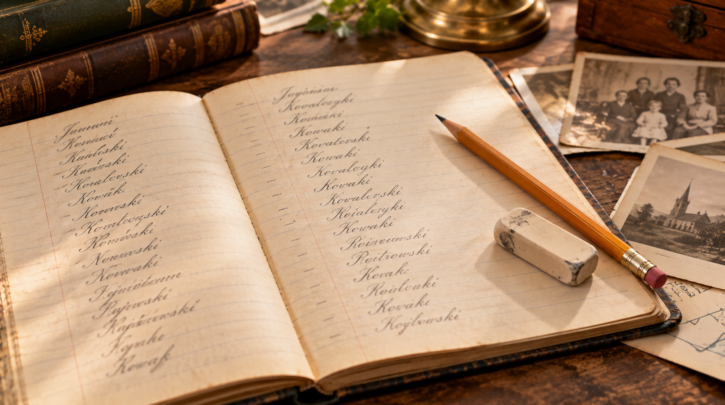

The Croatian surname you are searching for may appear in the records under a spelling that looks like a different family. Croatian surname spelling varied with the language of the record, with the clerk’s alphabet, with the passport office and sometimes with the family’s own business habits. This guide sets out the documented variants of Croatian surnames: the -ić ending and its American, German and Hungarian forms, the Italian handling of the letter K, the double names Dalmatians and Istrians used, the effect of Italianization and the problem of indexes. It ends with a search method. It draws on reference articles on Slavic name suffixes, the Cultural Atlas, a Croatian genealogy guide and a DNA project’s background page, as of October 2026.
One ending, many spellings
A reference article on Slavic name suffixes lists the patronymic family of endings as -ović and -ević, -ić and, in other languages, -ovič and -ević, -ič, -icz, -owicz and -ewicz. It identifies -ich as the American spelling and -owitz or -ovitz as German spellings. The Cultural Atlas says it is common for Croatian surnames to have the suffix -ić, and that some family names have the anglicized form of the suffix, -ich. A reference article on Serbian names adds that Serbs in Hungary have the endings -ity, -ics and -its. That is a Serbian example, but it shows the Hungarian-language pattern, and Hungarian was a language of civil documents in the Austria-Hungary period, according to FamilySearch.
| Form | Where the sources say it appears | What it tells you |
|---|---|---|
| -ić | The standard Croatian spelling | Search first for this form |
| -ich | The American spelling, according to a reference article and the Cultural Atlas | Expect it in North American records, and in some Italian-influenced ones |
| -owitz and -ovitz | German spellings, according to the same article | Expect it in Austrian-period documents in German |
| -ics and -its | Hungarian-language forms among Serbs in Hungary, according to a reference article | Expect similar forms in Hungarian civil documents |
| -ovič and -ič | Forms in other Slavic languages, according to the article | May appear in records that crossed the border |
Free Download
Not sure where to start with your Croatian ancestry?
Get the Croatian Genealogy Quick-Start Checklist: six research steps in order, the six terms you’ll see everywhere (matične knjige, župa, status animarum and more), and the one free record collection to bookmark first.
The Italian alphabet and the letter K
A guide to Croatian genealogy by a Croatian genealogical society gives a clear example of an alphabet effect: the Italian alphabet has no K, so a man named Kristović from Dalmatia or Istria would be registered as Christovich on his passport. The guide notes that the majority of the emigrants it describes came from Dalmatia and Istria, with a strong Venetian-Italian influence. For a researcher, the lesson is to search the K form and the Ch or C form, and, for the ending, both -ić and -ich. The Italian form is not an error. It is the clerk’s way of writing the sound.
Two names for two audiences
The same guide says that some people from Dalmatia or Istria used two versions of their name for business reasons, such as Mladinić and Mladineo, or Marijanović and Mariani. These examples show an Italian-sounding form used beside the Croatian one, which is different from the forced changes we cover in our guide to the 1926 decrees. A family may therefore appear in the same decade under two surnames by choice, and a register may use either. The DNA project background page for the surname Poropat shows a related case: the suffix -ić or -ich oscillated and vanished over the centuries in Istria, and during Italian rule the name was written as Poretti.
Name order, diacritics and indexes
- Name order. The traditional Croatian convention puts the family name first, as in Kačić Ivan, according to the Cultural Atlas, so an index or list may reverse the order you expect.
- Diacritics. We did not find a source that explains how FamilySearch’s index or ARHiNET treat the letters with marks, such as ć and č. Search with and without the marks.
- Scripts. FamilySearch says Glagolitic and Cyrillic scripts occur in Croatian records alongside the Roman one, so a surname may be written in a script you do not read. See our guide to reading a register.
- Women’s names. A woman may be listed under her husband’s name or under both names, as our surnames guide explains.
Free trial
Ready to put your research into a family tree?
Start a free MyHeritage trial to build your tree online and search historical records and other family trees as you add each generation.
A search method for variant spellings
- Write the surname as your family spells it and as the earliest record spells it.
- Find the stem, the part before the ending, and list the endings the sources document: -ić, -ich, -ović, -owitz, -ics.
- List alphabet variants, such as K and Ch, and the Italian and German forms of the stem.
- Search each form in the record language it belongs to, with and without diacritics.
- Confirm any candidate with the parents’ given names, the godparents and the village, using our given names guide, and not with the surname alone.
- Record every form as a variant of one family, and choose a working spelling, usually the Croatian form with its marks.
A worked example, invented for illustration
Example (invented, for illustration only): A reader’s family name is Kristović, and her grandfather’s U.S. passport says Christovich. She searches the Dalmatian parish register for both forms and for the Italian-influenced ending, finds a baptism under Kristović and checks the parents and godparents against the passport’s birthplace. She records Christovich as a variant, notes that the Italian alphabet explains the Ch, and keeps Kristović as her working name.
What we could not verify
- How the main indexes handle diacritics.
- How often each variant occurs in a given region or period, since the sources give examples, not counts.
- Whether passport spellings differed by consulate or by period.
- A complete mapping of Croatian endings to Italian, German and Hungarian ones.
Sources include a reference article on Slavic name suffixes, one on Serbian names, the Cultural Atlas on Croatian naming, a guide to Croatian genealogy, a DNA project’s background page on the surname Poropat and FamilySearch’s page on Croatian church records. The DNA project page and the genealogical society guide are volunteer-run sources.
This guide belongs to Family Names & Place Names. See also the guide to place names for the matching problem with villages.
Disclosure: Croatian Roots may earn a commission if you buy through some links on this page, at no extra cost to you. Our affiliate disclosure explains how we handle that.
