
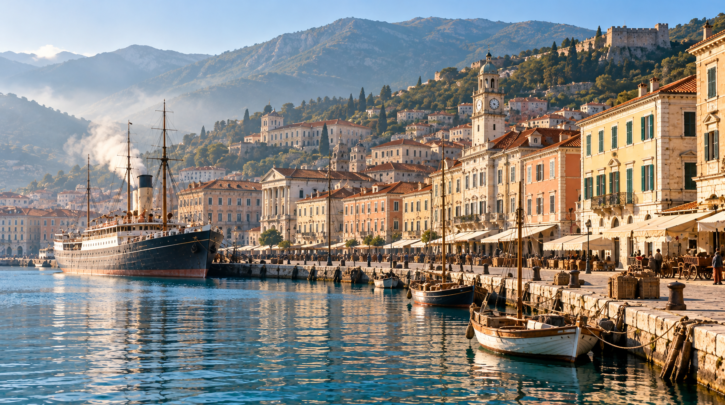

A family from Rijeka may have been born in Fiume, married in a city administered from Budapest, lived under an Italian government and died in Yugoslavia, all without leaving the same street. Few places in Europe changed ruler as often or in as many layers as this port on the Kvarner Gulf. For genealogists the consequence is practical: the name of the city, the language of the paperwork and the archive that inherited it all depend on the year. This guide explains Rijeka and Fiume genealogy through its rulers, sets out the dates that matter, notes the separate case of Sušak and says where we could not confirm the records. It draws on reference articles, a city history page and the FEEFHS list of Croatian archives, as of October 2026.
A city that was not part of Croatia
A reference article on the corpus separatum says that Empress Maria Theresa, in a royal rescript dated 23 April 1779, made the City of Fiume directly subject to the Hungarian Crown as a corpus separatum, that is, not as a part of Croatia, which was in personal union with Hungary. A separate article says the city was attached to the Hungarian crown in 1776. The district was tiny: Fiume and its district had a total area of 21 square kilometers and comprised the city and three villages. The common languages of the corpus separatum were Italian, Croatian, Slovene, Hungarian and German, according to the article.
The status was disputed. The Croatian-Hungarian Settlement of 1868 left the possession of Fiume unsettled under its article 66 in the Croatian version, while the Hungarian version declared the city a corpus separatum directly connected to the lands of the Crown of Saint Stephen. The city’s own history page calls this article the Rijeka patch, riječka krpica. Fiume was not part of the neighboring Modruš-Rijeka County, but was under the direct administration of Hungary, according to another reference article. The administration of the corpus separatum was settled by a statute given on 17 April 1872. For a researcher, this means civil documents of the period 1779 to 1918 may follow Hungarian administrative patterns, even though the city was largely Italian-speaking and Croatian was spoken around it.
Free Download
Not sure where to start with your Croatian ancestry?
Get the Croatian Genealogy Quick-Start Checklist: six research steps in order, the six terms you’ll see everywhere (matične knjige, župa, status animarum and more), and the one free record collection to bookmark first.
The dates that matter
| Date | What happened | Why it matters for records |
|---|---|---|
| 1776 and 1779 | Attached to the Hungarian crown, then made a corpus separatum | Hungarian administrative framework begins |
| 1868 and 1872 | The Settlement leaves Fiume’s status unresolved, and a statute regulates its administration | Hungarian suzerainty with municipal self-rule |
| 29 October 1918 | Hungarian suzerainty ends | A gap, with Croatian and Italian claims |
| 1920 to 1924 | The Free State of Fiume exists under the Treaty of Rapallo, with Sušak conceded to the Kingdom of Serbs, Croats and Slovenes | A short-lived state with its own paperwork |
| 1924 | Annexed to Italy under the Treaty of Rome, and later part of an Italian Province of Fiume | Italian civil records |
| 1925 | Rijeka’s diocese was founded | A new church jurisdiction |
| 3 May 1945 and 1947 | Captured by Yugoslav forces, then formally ceded by the Paris peace treaty with Italy | Yugoslav, then Croatian records |
The dates come from reference articles on the Free State of Fiume, the history of Rijeka and the list of Fiume’s governors, and from the city’s tourism history page. The state ended de facto on 3 March 1922 and de jure with the 1924 annexation, according to a flag-history page, which is a good example of how one place can have two end dates.
Sušak, the neighbor outside the line
A reference article on the Fiume question explains that the Italian side held that the city was limited to the territory of the corpus separatum, while the Yugoslav side claimed that the suburb of Sušak, located outside it, was an inseparable part of the city. Under the Treaty of Rapallo, Sušak was conceded to the Kingdom of Serbs, Croats and Slovenes. For family history, the point is simple: a family said to be from Rijeka may have lived in Sušak, in a different state from 1920, with different records. Try both names.
Names, languages and spellings
- Fiume and Rijeka. The city is called Fiume in Italian and in Fiuman Venetian, according to a reference article. Search both, and also the Croatian and Hungarian forms where a document is in those languages.
- Italian. Italian was the official language of the Free State of Fiume, according to the reference article, and Italian civil records of 1924 to 1945 may name a family under an Italianized surname.
- Hungarian. FamilySearch lists Hungarian among the languages of civil documents of the Austria-Hungary period. We could not confirm how this applied inside the corpus separatum.
- Croatian. The surrounding Croatian lands used Croatian and Latin in the registers, as our guide to reading a register explains.
Free trial
Ready to put your research into a family tree?
Start a free MyHeritage trial to build your tree online and search historical records and other family trees as you add each generation.
Where the records are
The State Archive in Rijeka appears in the FEEFHS list of Croatian state archives, and FamilySearch lists records from the Rijeka State Archives among its Croatian microfilming. We did not find a published description of what the Rijeka archive holds for the corpus separatum or for the Italian period, so write to it with the subject genealogy if you are researching a family from the city, and ask which registers cover the parish. For the diocese, remember that Rijeka’s diocese was founded in 1925, which may affect which church unit recorded a later event. Our archives guide explains how to write.
A worked example, invented for illustration
Example (invented, for illustration only): A reader’s grandmother was born in 1921 in a house she always called Rijeka. The reader notes that 1921 falls inside the Free State of Fiume, that Italian was the official language there and that the house may have stood in Sušak, which was conceded to Yugoslavia in 1920. She searches for the baptism under both Fiume and Sušak, expects an Italian or Croatian entry and writes to the Rijeka State Archive to ask which parish registers cover each place.
Questions for a Rijeka line
- Was the family inside the corpus separatum, in Sušak or in the surrounding Croatian lands?
- Which state governed the place in the year of the event?
- Which language and name form will the record use?
- Which parish and diocese recorded it, noting that the diocese dates from 1925?
- Which archive holds the register?
What we could not verify
- What the Rijeka State Archive holds for the corpus separatum and the Italian period.
- Whether Hungarian civil registration, which began in 1895 across Hungary according to a Jewish research guide, applied in the same way in Fiume.
- How the Free State’s own records survive.
- Fees, turnaround and hours at the archive.
Sources include a reference article on the corpus separatum, one on the Free State of Fiume, one on the history of Rijeka, one on the Fiume question, a list of Fiume’s governors, a city history page, a flag-history page on Fiume, a list of Croatian online records and a Hungarian Jewish research guide.
This guide is part of the regions and ruling states guide, and more are in Regions & Empires.
Disclosure: Croatian Roots may earn a commission if you buy through some links on this page, at no extra cost to you. Our affiliate disclosure explains how we handle that.
