
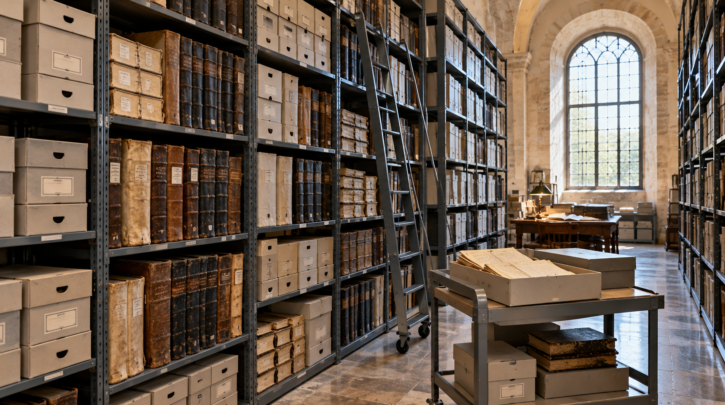

Once you know the parish and the period, the question becomes who holds the book. In Croatia the answer is rarely one place. The Croatian State Archives in Zagreb hold a large collection of registers, regional state archives hold others, some parishes still keep their own and some books exist only on microfilm. This guide explains how the Croatian State Archives and the regional archives divide the material, what their own pages say about genealogical research, how one regional archive organizes its register database, and how to write a request that gets an answer. It reflects the sources as of October 2026, and where figures disagree it says so.
What the Croatian State Archives say to researchers
The Croatian State Archives’ own genealogy page opens with preparation. Before arriving, a researcher should find out as much as possible about the history of the family: the names and surnames of ancestors and the dates and places of birth and death. It is also useful to learn about the place the family came from, to which administrative unit it belonged and in which parish the family lived. The page asks visitors to announce their arrival so that staff can gather information in advance, and it says that questions about registers of births, deaths and marriages, books of armorial bearings and other subjects can be sent to info@arhiv.hr with the subject genealogy.
The same page makes two points worth underlining. Sources for genealogical research are spread across many fonds and collections of the archives, not only the registers. And the archives also collect data on registers of births, deaths and marriages across the territory of Croatia, so even when they do not hold material relevant to your research, you can get general information about where such registers are kept and whom to turn to. The archives’ contact address for the reference service is Marulićev trg 21, 10000 Zagreb, according to the EHRI portal, and FamilySearch lists the same building as Trg Marka Marulića 21.
Free Download
Not sure where to start with your Croatian ancestry?
Get the Croatian Genealogy Quick-Start Checklist: six research steps in order, the six terms you’ll see everywhere (matične knjige, župa, status animarum and more), and the one free record collection to bookmark first.
How much is in the register collection?
Counts differ. A guide to Croatian archives says the collection of parish registers, catalogued under the reference HR-HDA-883, consists of 2,186 volumes of births, marriages and deaths from the seventeenth to the twentieth century, primarily for northwestern Croatia and to a lesser degree for Slavonia and the Croatian coast, together with 25 status animarum books from 17 parishes. A different page of the same guide gives about 2,864 original parish registers and 718 copies. FamilySearch’s page on Croatian archives says over 2,000 registers dating from the seventeenth to the twentieth century. The numbers may count different things, such as originals and copies, and we could not reconcile them. Use them for scale and ask the archives for the register list for your parish.
| Source | What it says about the registers at the State Archives | Note |
|---|---|---|
| A guide to Croatian archives, main page | 2,186 volumes, 17th to 20th century, mostly northwestern Croatia | Gives a collection reference |
| The same guide, another page | About 2,864 original registers and 718 copies, originals as early as 1621 | A different count |
| FamilySearch | Over 2,000 registers, 17th to 20th century | A round figure |
How the regional archives fit
FamilySearch says there are twelve district historical archives, and that registers more than 100 years old were transferred to archives in 1957, while registers before the First World War were transferred to town halls and the churches kept the post-war registers. It lists microfilming from the state archives in Zadar, Split, Dubrovnik, Rijeka, Pazin, Osijek and Varaždin. The details below show how differently two regional archives present their material.
- Pazin (Istria). The State Archives in Pazin publish a database of registers that, at the time we looked, listed 6,155 records. Civil registers are arranged alphabetically by the name of the parish or place and, within each, by type: born or baptized, married, deceased and state of souls. Researchers use the reading room with a prior application, and the archive provides an application form for copies, according to its page.
- Bjelovar. The State Archives in Bjelovar preserve registers of Roman Catholics, Greek Catholics, Orthodox Christians, Jews and Evangelicals from its area. The whole collection has been microfilmed at the Croatian State Archives and is partially digitized, and some content still requires onsite consultation or a formal request, according to a guide to Croatian archives.
- Istria in general. A Legacy Tree article says the majority of registers for Croatian Istria are held by local parishes or in the archives of Pazin, Poreč, Rijeka or Trieste, that smaller parishes were sometimes incorporated into a larger neighbor whose books then hold the entries, and that the Pazin archive keeps a list of parish registers and family books for all of Istria. The article is several years old, so confirm it.
Free trial
Ready to put your research into a family tree?
Start a free MyHeritage trial to build your tree online and search historical records and other family trees as you add each generation.
Writing a request that works
- Write first to the archive that is likeliest to hold the parish, or to the State Archives with the subject genealogy if you are unsure. The State Archives collect data on where registers are kept.
- State the faith, the parish, the village, the surname with every spelling you know, and the years you want searched. Our five-layer guide explains how to get those facts.
- Say whether you want a search, a copy or a visit, and, if you will come, announce the date in advance as the archives ask.
- Ask about fees and turnaround before you commission a search. We found no published fee schedule or turnaround time on the pages we read.
- Keep a log of the date, the archive and the reply.
The State Archives’ site is available in English and Croatian, according to a reference article. A short, specific message with the surname and parish is more likely to be answered than a long family history.
A worked example, invented for illustration
Example (invented, for illustration only): A reader’s family came from a village in the Istrian interior. She finds that the village has no register of its own and learns from an article that smaller parishes were sometimes folded into larger neighbors. She writes to the Pazin archive’s reading room with the village, the surname spellings and the years, asks which parish’s registers would cover the village and requests an application form for copies. In parallel, she emails the Croatian State Archives with the subject genealogy and asks whether microfilm copies exist.
What we could not verify
- Fees, turnaround times and the current reading-room hours at any of these archives.
- Whether the State Archives still take the same contact details as the older FamilySearch and EHRI pages give.
- The reconciliation of the register counts.
- How current the Istria details are, since they come from an older article.
Sources include the Croatian State Archives’ genealogy page, the EHRI portal’s entry for the archives, FamilySearch’s page on Croatian archives, its page on Croatian church records, a guide to church records and archives in Croatia, the Pazin archive’s page on registers, a Legacy Tree article on Istria and a reference article on the Croatian State Archives.
More guides are in Parish Books & Archives, and the records map shows which periods each holder covers.
Disclosure: Croatian Roots may earn a commission if you buy through some links on this page, at no extra cost to you. Our affiliate disclosure explains how we handle that.

HELLO WHERE CAN I FIND A BIRTH CERTIFICATE OR CHURCH FILES OF MY GREAT GRAND FATHER
LUKA JOVO PAVLOVICH, HE WAS BORN IN RIJEKA YEAR 1871 HIS FATHER JOVO PAVLOVICH AND MOTHER ANASTASIA VUCOVICH
Hi Juan,
For 1871, you’re looking for a parish baptismal record rather than a civil birth certificate — civil registration wasn’t yet in place in Rijeka/Fiume at that time, so Catholic church records are the primary source.
Most of the historical parish registers for Rijeka are held at the State Archive in Rijeka (Državni arhiv u Rijeci), which holds the city’s baptismal, marriage and death registers going back to the 1800s. Many Croatian parish registers from this period have also been microfilmed by FamilySearch and are searchable/browsable for free in their catalog — worth checking there first for “Fiume” or “Rijeka, Croatia” church records before contacting the archive directly.
Since you already have the father’s name (Jovo Pavlovich) and mother’s name (Anastasia Vucovich), that’s exactly the kind of detail that’ll make it easy to confirm the right entry once you find the register for that year.